MURALI ARCHITECTS PARTICIPATION AT PULSE 2025, BENGALURU
PULSE 2025 brought together architects, educators, and K12 school-owners to explore the future of learning spaces—how design, pedagogy and environment combine to create impactful educational architecture.
The theme revolved around how ‘learning spaces’ are evolving—from static classrooms to dynamic, participatory, and inclusive environments. It was a two-day deep-dive into ideas, strategies and real-world case-studies.
As Murali Architects, our participation at PULSE 2025 reinforces our belief that architecture isn’t just about buildings—it’s about creating experiences, communities, and futures.
Thank you to GLSN, the organisers, all the speakers, and the attendees for making PULSE 2025 such a rich, inspiring experience. We look forward to more such exchanges, co-creation and transformation
Mahabalipuram Museum: A Vision Proposal by Murali Architects for the Government of Tamil Nadu
Rooted in the ancient spirit of Mahabalipuram, Murali Architects presents this visionary proposal for the Mamallapuram Museum to the Government of Tamil Nadu, honourably submitted to the Chief Minister. As a 4.5-acre cultural landmark, the project reflects our firm’s deep experience in designing large-scale, complex public institutions.
The design reinterprets the city’s sculptural heritage through sweeping curves and monumental forms, anchored by a grand circular canopy inscribed with flowing Tamil script. Sunlight filtering through these etched letters animates the plaza with shifting patterns of language and light.
The canopy becomes a symbol of identity — inspired by Pallava inscriptions and the timeless beauty of Tamil epigraphy — transforming architecture into a vessel of memory. Around this luminous centre, sculpted stone volumes echo the rock-cut caves and iconic forms of Mahabalipuram, creating a clear, intuitive visitor journey through stories carved in stone.
Landscaped pathways converge into a ceremonial court, shaping a communal space where culture is experienced, not merely observed. The script-lit canopy welcomes every visitor with a sense of belonging.
Rooted in the timeless essence of Tamil civilization, this museum stands as a living reflection of the land’s enduring spirit — its art, people, and cultural rhythm. The design draws inspiration from the forms and spatial languages once shaped by the early Tamil civilization — the flowing silhouettes of pottery, the geometric precision of ancient settlements, the patterns etched in stone, and the textures carved by time itself.
These elemental forms are reinterpreted through modern and futuristic expressions, creating an architecture that speaks both of memory and possibility. It becomes a bridge between the past and the present — a dialogue where tradition meets transformation, and heritage evolves into new meaning.
More than a space for preservation, this museum embodies the life and soul of Tamil culture — its strength, warmth, and creativity — translated into structure, light, and material. Each gallery unfolds a story of resilience and artistry, echoing how a civilization once lived, built, and dreamed.
Designed to be embraced by the local community, the museum seeks to revive lost cultural engagement and inspire new creative activism. It stands not only as a monument to history but as a living canvas for identity, ensuring that the pulse of Tamil civilization continues to shape the world of tomorrow.
Dr. Krishnamoorthy, a young and esteemed doctor, has shared a longstanding association with MA. Our journey together began with the design of his hospital, followed by the seamless integration of a laboratory. His decision to entrust us with his residence is a testament to the confidence he places in our expertise.
Designing this residence presented a unique challenge, as the client held a strong belief in Vastu. However, rather than limiting our creative exploration, it became an opportunity to merge traditional principles with innovative spatial design. The facade, sculpted with fluid, flowing forms, stands as a testament to meticulous engineering and artistic precision.
The color palette exudes earthy warmth, further enhanced by the lush greenery that envelops the residence. Spanning 9,000 sq. ft., the house features a striking Muttram (courtyard)—a column-free expanse that fosters seamless movement and floods the interiors with natural light, reinforcing a deep connection with nature.
This residence is more than a home; it's a living canvas where age-old wisdom meets contemporary aesthetics, offering a serene, balanced space that supports both togetherness and solitude in equal measure
Highway restaurant by MA team….This is more than just a stop along the highway, it’s a space where journeys slow down, people meet, and conversations flow.
From quick bites for travelers to quiet corners for families and fine dining under the skyline, the restaurant embraces every mood and every age. It welcomes big family gatherings, friendly evenings, and those little celebrations that bring people closer. With a signature 360° view tower and a lush landscape all around, the place comes alive through not just food, but through moments of interaction.
It’s a pitstop that refreshes, a hangout that engages, and a memory that stays with you long after the journey continues.
The annual Creative Colour Awards (CCA) celebrates projects that exhibit an innovative and purposeful use of colour in spatial design, recognising that the colours surrounding us can make a profound difference in our lives. The recent Award Ceremony in Tokyo was a stunning showcase of this principle, bringing together visionary architects and designers from across the region. This year, the awards received 188 submissions from 10 countries and regions, all demonstrating how colour can transform the built environment with purpose and imagination.
A Vision for Colour as a Force for Change
Setting the tone for the celebration, our leadership shared their vision for the role of colour in the future of design. In his opening address, Yuichiro Wakatsuki, Director, Representative Executive Officer & Co-President, highlighted the CCA’s distinct mission. “The Creative Colour Awards,” he noted, “allow us to celebrate outstanding colour mastery and the purposeful use of colours in spatial design among practitioners.” He emphasised that even “a small shift in colour can make a world of difference”.
In his closing remarks, Wee Siew Kim, Co-President of the Nippon Paint Group & Group CEO of NIPSEA Group, celebrated the winners’ innovative thinking. “Congratulations on your win,” he stated. “Your submissions have truly exemplified how colour can be used as a language and tool to solve problems, signal change and signify new possibilities.”
What Makes a Winning Project? A View from the Jury
The esteemed jury panel shared its insights on what it looks for in an outstanding project. Gladys Goh emphasised that the awards bring awareness to “how colours can impact design goals.” Francesca Heathcote Sapey agreed, stating that the use of colour “has to have meaning, it can’t be random… it has to go beyond the aesthetics to be of use.” For IDr Lai Siew Hong, the key is how colour can “impact and tell a story in the project and how it impacts lives and people.” Judge Nevzat Sayin offered a poetic analogy, comparing colours to “punctuation marks in literature,” explaining that “we need them to tell a story.”
Announcing the Grand Prix Winner: GB School by Murali Architects
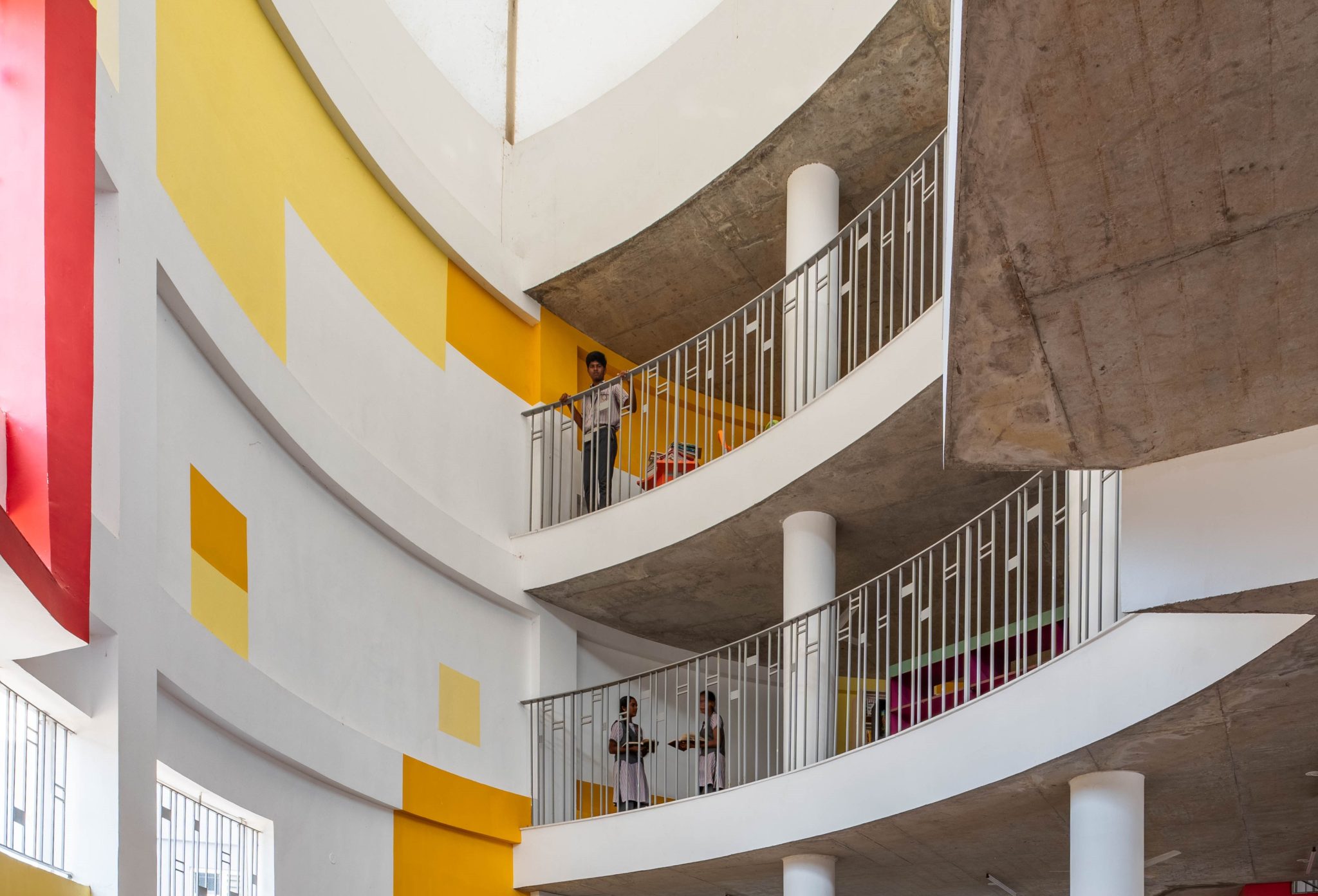
The award’s highest honour, the Grand Prix award, was presented to GB School in Tamil Nadu, India, designed by Murali Architects. Architect M Murali, who was present with his wife, expressed his surprise. “I was thinking, ‘Oh, what happened, I didn’t make it,’ but then it was a great surprise,” he shared.
The story behind the project is one of deep social purpose. After discovering the school was for underprivileged children from surrounding villages with poor living conditions, Ar. Murali’s mission became clear: “The school should become like a heaven.” The design uses a “splash of colour everywhere” to elevate moods and bring happiness. “Colour always welcomes,” Ar. Murali explained. “It is like hugging you… It’s like holding you.” The result is a space where he says, “Every child loves it.”